RAY (Thailand)Cosmetics Manufacturing
    Request a Quote

    August 3, 2026

    OEM vs ODM vs Private Label: A Per-Unit Cost Comparison

    Explore the key cost differences between OEM, ODM, and Private Label manufacturing. This guide helps you choose the most cost-effective model for your beauty brand's needs.

    By RAY (Thailand) Editorial Team

    OEM vs ODM vs Private Label: A Per-Unit Cost Comparison

    Navigating the World of Cosmetics Manufacturing: OEM, ODM, and Private Label

    Launching a cosmetics brand is an exciting venture, but one of the most critical early decisions you'll make is choosing the right manufacturing model. This choice directly impacts your product development timeline, level of control, and, most importantly, your per-unit cost. Three primary models dominate the industry: Original Equipment Manufacturer (OEM), Original Design Manufacturer (ODM), and Private Label. Understanding the financial implications of each is key to building a profitable and scalable brand. At RAY, we partner with brands across all three models, providing expert guidance to align your production with your budget and vision.

    Breaking Down the Manufacturing Models

    Before diving into a cost comparison, it's essential to understand how each model works. They exist on a spectrum, offering a trade-off between customization and cost.

    Original Equipment Manufacturer (OEM)

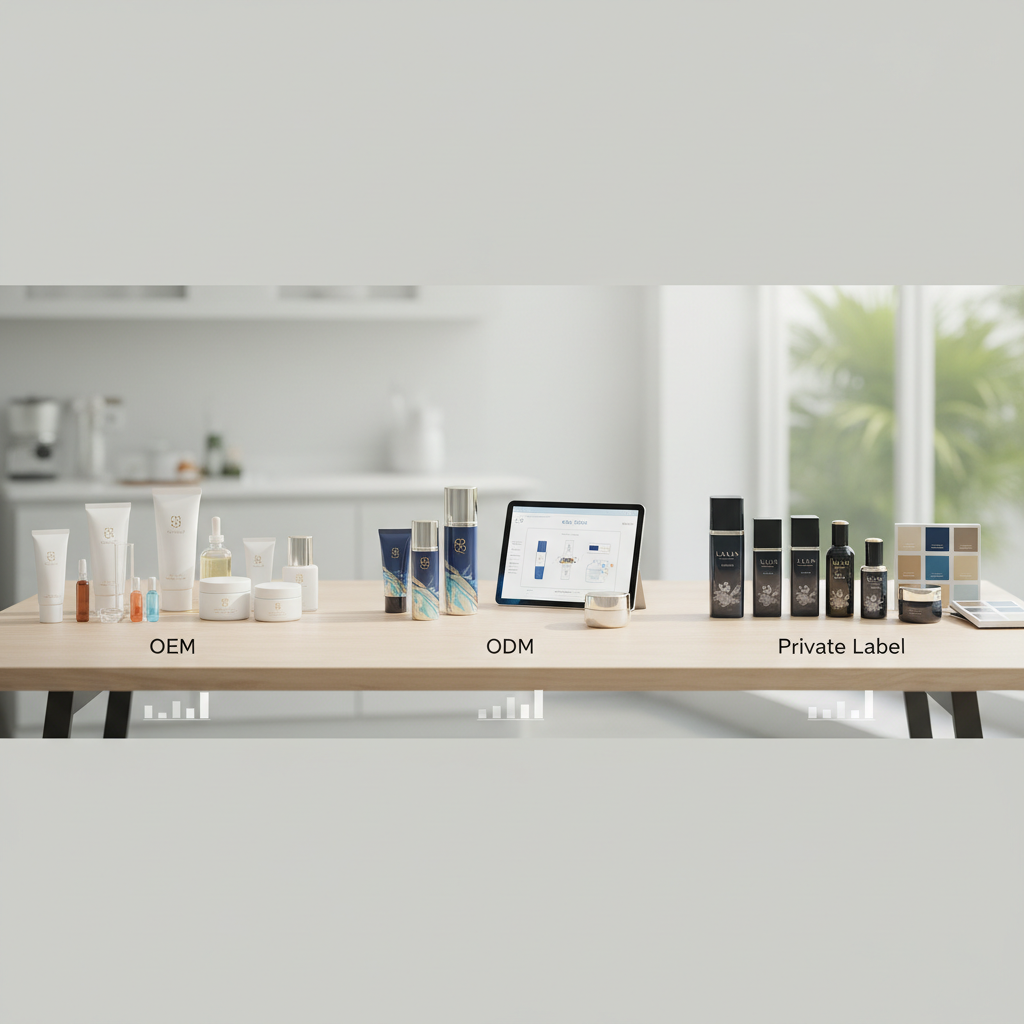
    In an OEM partnership, you, the brand, are responsible for the research, development, and design of your unique product. You provide the manufacturer (like RAY) with a complete formula, detailed specifications, and production requirements. We then act as your production house, using our equipment and expertise to manufacture the product exactly as you designed it. You retain full ownership of the intellectual property (IP).

    Original Design Manufacturer (ODM)

    With an ODM model, the manufacturer has already developed a range of market-tested and stable product formulas. You select a base formula from their catalog that aligns with your brand's needs. From there, you can request modifications to aspects like fragrance, color, or the addition of specific active ingredients. The manufacturer handles the core R&D, and you focus on branding, packaging, and marketing. This is often called a "semi-custom" approach.

    Private Label

    Private Label is the most straightforward and fastest route to market. The manufacturer offers a selection of ready-made, off-the-shelf products that you can simply brand with your own logo and packaging. There is typically little to no room for formula customization. You are essentially selecting a finished good from a catalog, allowing you to launch a product line very quickly and with minimal upfront investment in development.

    A Per-Unit Cost Comparison Across Models

    The single most significant factor differentiating these models is the per-unit cost. This cost is influenced by R&D investment, tooling, testing, and order volume.

    OEM: Highest Initial Investment, Scalable Returns

    OEM typically involves the highest per-unit cost, especially on initial production runs. This is because your brand absorbs all the upfront costs associated with creating a new product from scratch. These include:

    • Research & Development (R&D): Formulator fees, ingredient sourcing, and stability testing.

    • Tooling & Molds: If you require unique packaging components, creating custom molds is a significant one-time expense.

    • Compliance & Testing: Extensive testing is required to ensure a new, unique formula is safe, stable, and effective, adding to the cost.

    While the initial per-unit price is high, it can decrease significantly as you scale. Once the development costs are paid, larger production volumes will bring the per-unit price down, offering excellent long-term profitability if the product is successful.

    ODM: The Balanced, Mid-Range Cost

    ODM represents a middle ground in terms of cost. The manufacturer has already covered the expensive R&D and stability testing for the base formulas. Your costs are more predictable. The per-unit price is primarily composed of:

    • The cost of the base product itself.

    • Fees for any requested customizations (e.g., adding a specific botanical extract).

    • Packaging and branding application.

    Because the formulas are pre-developed and often produced for multiple clients, manufacturers achieve economies of scale that they can pass on to you. This makes ODM a cost-effective way to launch a semi-custom product without the financial risk of full OEM.

    Private Label: The Lowest Per-Unit Cost

    Private Label offers the lowest per-unit cost. This is the most accessible entry point into the market from a financial perspective. The low cost is possible because:

    • Zero R&D Costs: You are not paying for any development, testing, or formulation.

    • Massive Economies of Scale: The manufacturer produces these stock products in vast quantities for numerous brands, driving the production cost down to the lowest possible point.

    • Low Minimum Order Quantities (MOQs): Private label often has the lowest MOQs, making it ideal for startups or for testing market demand for a new product category.

    Key Factors That Influence Your Final Cost

    Regardless of the model you choose, several variables will always impact your final per-unit price:

    • Ingredient Quality: Sourcing rare, certified organic, or technologically advanced active ingredients will raise the cost in any model.

    • Packaging Complexity: Custom glass bottles, airless pumps, and multi-layered screen printing are more expensive than standard plastic tubes and simple labels.

    • Minimum Order Quantity (MOQ): This is a universal rule in manufacturing. The larger your order, the lower your per-unit cost will be as fixed costs are spread across more units.

    Which Model Is Right for Your Brand?

    Choosing a manufacturing partner is about more than just cost; it’s about strategic alignment.

    • Choose OEM if: You have a truly innovative product idea, a healthy budget for R&D, and your primary goal is to own a unique formula and protect your intellectual property.

    • Choose ODM if: You want to launch a high-quality, differentiated product line quickly without the heavy investment of starting from zero. You value speed-to-market but still want a product that feels unique to your brand.

    • Choose Private Label if: Your top priorities are speed, minimizing financial risk, and testing a concept. It’s perfect for new entrepreneurs, established brands expanding into a new category, or for creating promotional items.

    At RAY, we pride ourselves on our flexibility and expertise. We don't just manufacture products; we build partnerships. Whether you come to us with a finished formula (OEM), want to explore our extensive library of innovative bases (ODM), or need a fast, reliable private label solution, our team is equipped to guide you toward the most effective and profitable path. Contact us today to discuss your vision.